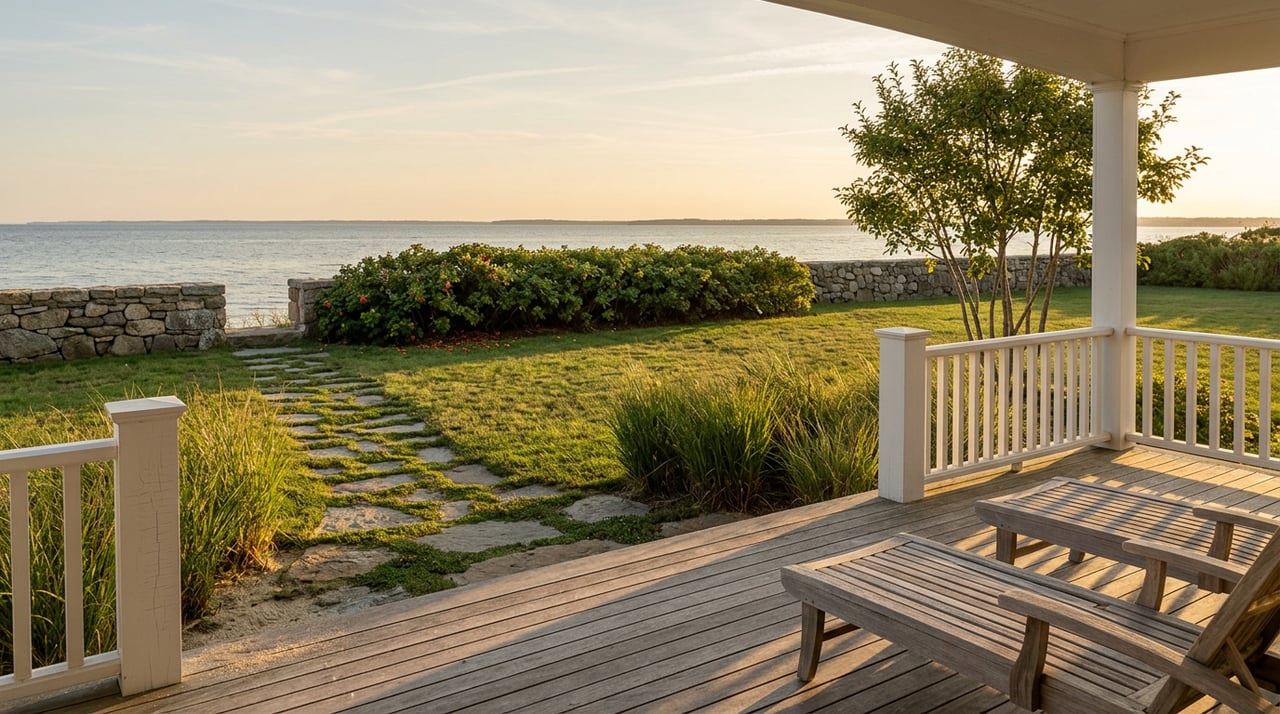
Brant Point Waterfront Mooring Rights: What Buyers Should Know
September 17, 2026
September 17, 2026
Every October, the Town of Nantucket holds its annual lottery for a limited number of slips at the Town Pier, under Chapter 278 of the town code. Winners in Category A get to renew the following year without re-entering the drawing. Category B winners go back into the pool every single season. Anyone who forfeits a slip watches it pass to the next name on a waiting list they cannot see or control. It is an orderly system, and it is also proof of how much competition exists for a place to keep a boat in Nantucket Harbor.
None of that applies if you already own the water's edge on Brant Point.
The town's own harbor planning documents are direct about this: waterfront property owners have a right to moor in front of their own property, a right the town has openly used as pressure relief for its own oversubscribed mooring list. For a buyer comparing two Brant Point properties at a similar price, one with recognized harbor frontage and one set back from it, that single clause is worth more than the square footage difference. It is the reason a house on Walsh Street with harbor access can command a premium that has nothing to do with its floor plan.
The Town of Nantucket's harbor bylaw lays out two separate systems for anyone without waterfront of their own. The Town Pier slip lottery runs every October under Chapter 278 of the town code. Category A slips renew automatically for a second season as long as the holder stays current on payments and compliant with town rules. Category B slips do not carry over. Every holder goes back into the lottery pool the following year, no exceptions.
Chapter 278 says that if a permit holder forfeits, the slip goes to the next name on the waiting list.
Separately, the Harbormaster's office administers the general mooring permit system for the harbor itself, which the town's own planning materials describe as long, though it moves faster than it used to. Every permit on that list requires annual renewal, a mechanism the town has said exists specifically to keep the list current rather than clogged with permits nobody is using.
That is the system a boat owner without direct water frontage has to work inside. It is patient, procedural, and entirely outside the buyer's control.
Waterfront ownership on Brant Point changes the equation because it comes with a mooring right attached to the property itself, not to a place in a queue. The town has flagged this explicitly in its own harbor planning notes as one of the mechanisms that has eased pressure on the general mooring field: when waterfront owners exercise their own frontage rights instead of drawing from the shared mooring inventory, it frees up capacity for everyone competing through the Harbormaster's list.
This is not a marketing phrase invented for a listing sheet. The Nantucket Yacht Club got its start on Brant Point piers more than a century ago, and the pattern of harbor-edge owners keeping boats off their own shoreline predates the current permit system entirely. What has changed is how scarce that arrangement has become relative to demand for a mooring anywhere in the harbor.
A short run of Brant Point homes between Walsh Street and Willard Street illustrates the scale of that scarcity. Only a handful of properties along that stretch carry direct access to a harbor beach, which means the pool of parcels where this frontage right actually applies is narrow even within an already small neighborhood. Buyers evaluating a listing there are not just pricing a house. They are pricing entry into one of the few groups on the island that never has to think about the October lottery or a wait for the next available mooring at all.
| Non-waterfront path | Waterfront ownership | |
|---|---|---|
| How you get in | Town Pier slip lottery (October) or Harbormaster's general mooring list | Mooring right for waterfront owners |
| Renewal | Category A renews automatically; Category B re-enters lottery yearly | Confirm permit-specific renewal requirements; no lottery for the frontage right |
| What happens if you miss a step | Forfeited slip passes to next name on waitlist | No comparable forfeiture risk tied to a queue |
| Supply constraint | Shared pool spanning roughly 1,800 harbor-wide mooring permits | Limited only by how much recognized frontage exists |
The right-hand column is what a buyer is actually underwriting when a Brant Point listing mentions harbor access. The dollar figure on the listing sheet rarely separates that value from the house itself, which means it is easy to miss unless someone is looking for it.
Confirm the renewal requirements for a specific mooring arrangement with the Harbormaster's office. Town planning discussions have also floated the idea of capping how many mooring permits a single owner can hold, a response to concern that some people accumulate more permits than they use. The cap is not settled policy, but it is worth asking about before closing, particularly if the plan involves keeping more than one boat.
A mooring right is not the same thing as permission to build new dock infrastructure. Any private structure extending into the harbor, from a small pier to an expanded mooring installation, falls under Chapter 91, the state licensing law administered by the Massachusetts Department of Environmental Protection. The town's own harbor planning notes describe compliance with Chapter 91 as an ongoing challenge, with confusion in some cases about whether existing structures are even properly licensed, and the town has said it wants more enforcement authority than the state currently allows it to have.
For a buyer who assumes a waterfront lot on Brant Point comes with an open door to add a private dock down the road, that assumption deserves scrutiny before an offer goes in, not after.
Does a Brant Point mooring right transfer automatically when the property sells? Confirm with the Harbormaster's office whether the parcel carries a recognized frontage right and whether any associated permit is active.
What if my Brant Point property has water views but not direct frontage? A harbor view is not the same as direct frontage. Confirm with the Harbormaster's office whether the specific parcel qualifies for the waterfront-owner mooring right, and consider the non-waterfront options described above.
Can I install a private dock instead of relying on a mooring? Only with a Chapter 91 license from the state, a separate process from the town's mooring system. The town has acknowledged enforcement gaps around existing dock compliance, which makes it worth confirming a property's licensing status rather than assuming a dock can simply be added later.
Brant Point rewards buyers who look past the view and into the deed itself. The house matters, but on this stretch of shoreline, what the property lets you do with the water in front of it is often the harder asset to replace. If you are weighing a Brant Point purchase and want a clear read on how a specific parcel's frontage and mooring standing actually pencil out, Jen Shalley Allen can help you start the conversation before you write an offer.
This article is general information, not legal, tax or financial advice. Consult a qualified professional about your situation.



Whether you're a year out or a week out, the right time to talk is before the listing hits the market. I respond to every inquiry personally, usually within 24 hours.