
On Hummock Pond Road, the Watershed Sets Your Bedroom Count, Not the Deed
August 13, 2026
August 13, 2026
As Nantucket Current reported, "It seems like a math equation to me," Board of Health member Ernie Strang said last month, describing how his board now reviews septic variance requests on Nantucket. He wasn't being dismissive. He was describing exactly how the rules work in the Hummock Pond corridor, where the size of a lot on paper and the size of the house you're allowed to build on it are governed by two different kinds of arithmetic.
Buyers touring Hummock Pond Road tend to assume the two track together: more acreage, more house. In most of Nantucket, that's roughly true. In the Hummock Pond Watershed Protection District, it isn't, because the ceiling on bedroom count is set by a nitrogen loading formula, not by the number on your deed. Two lots of similar size can carry very different buildable limits depending on where they sit relative to a watershed boundary and a sewer expansion line that most listing photos never mention.
Hummock Pond runs more than a mile from the middle of the island down to the ocean at Cisco Beach, and the road that shares its name threads through a working landscape as much as a residential one. Drive it and you pass Bartlett's Farm, Cisco Brewers, and the 167 Raw seafood market before the houses give way to Land Bank conservation land, including the 41-acre Gardner Farm parcel and the trail network connecting to Sanford Farm and Ram Pasture off Madaket Road.
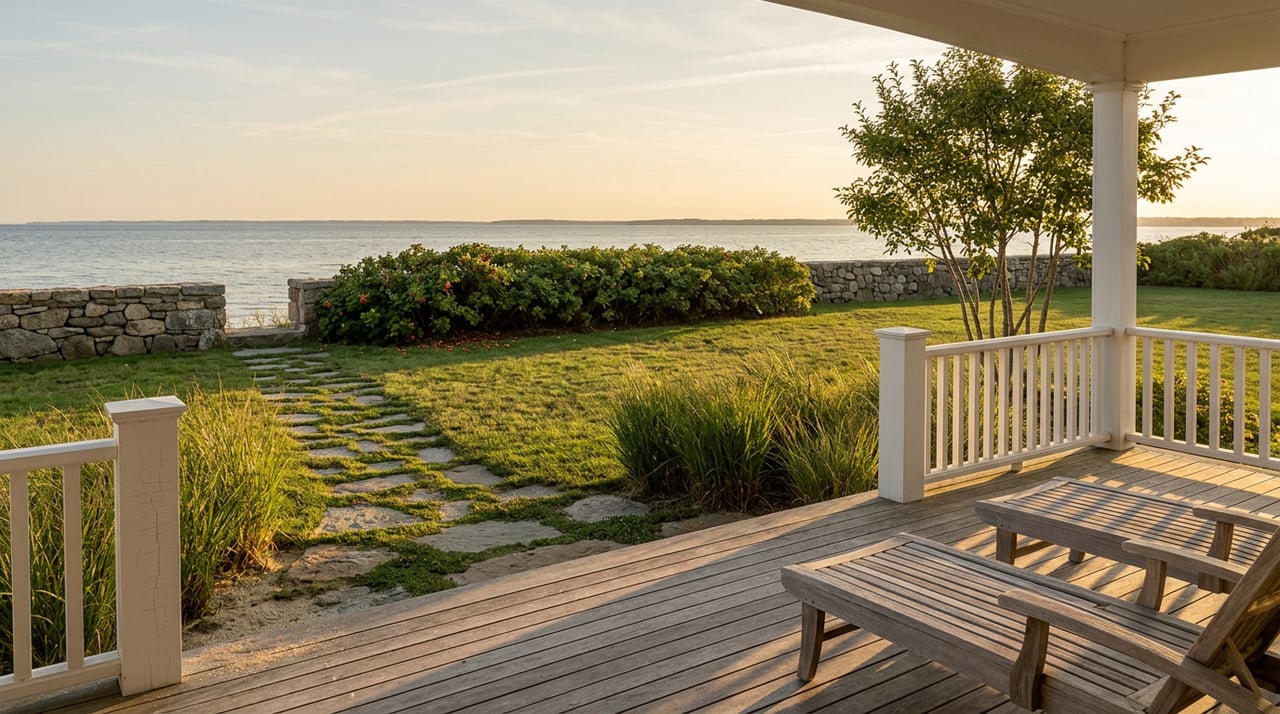
A 2.5-acre listing at 95 Hummock Pond Road that came on the market in June 2026 at $4,150,000 captures the corridor's character well. The property spans from the road to Pumpkin Pond Farm and abuts more than ten acres of Land Bank land, with the Hummock Pond Road bike path running past the house on its way to the south shore beaches. The existing structure has three bedrooms. That's not a coincidence of taste. It's a reflection of how little the septic math actually constrains a lot this size, which is a different situation than a buyer will find on the smaller parcels closer to the village edge.
The Hummock Pond Watershed Protection District applies a rule that reads plainly enough on paper: no new or reconstructed septic system may be designed to receive more than 110 gallons of effluent for every 10,000 square feet of lot area. Translated into bedrooms under the state's Title 5 code, that works out to one bedroom per 10,000 square feet of lot.
Run the math on a 20,000-square-foot lot and the cap is two bedrooms. Run it on 95 Hummock Pond Road's 2.5 acres, or roughly 108,900 square feet, and the theoretical ceiling is closer to ten. That gap is the whole point. On a large conservation-abutting parcel, the nitrogen formula barely registers. On a smaller in-fill lot nearer Somerset or the village side of the corridor, it's the single hardest constraint in the deal, harder than setbacks, harder than the Historic District Commission would ever be on this stretch of road.
The Board's rule changes and its handling of the Woodland Drive project were reported by Nantucket Current. For years, homeowners in nitrogen-sensitive districts could ask the Board of Health for a variance, offering to install an Innovative/Alternative septic system in exchange for a bedroom or two beyond what the lot's square footage would otherwise allow. The logic was straightforward: an IA system removes more nitrogen than a conventional one, so the environmental math still worked even with extra bedrooms.
That option narrowed. Within the last year, the Board tightened its regulations to largely block those variances in two areas of the island, the Wellhead Protection District and the Hummock Pond watershed. Homes in these districts must now switch to an IA system without gaining any additional bedrooms if the property changes hands.
"It seems like a math equation to me." — Ernie Strang, Nantucket Board of Health, as quoted by Nantucket Current
The Board's recent handling of a Woodland Drive housing project shows how far the pendulum has swung toward the pure numbers. That project had required a special waiver to exceed the standard bedroom cap, which the Board granted conditionally, capping the buildout at 12 units and attaching an age restriction. New members later voted to lift those added conditions, arguing they exceeded what a health board should be deciding in the first place. The bedroom formula stayed. The discretion around it didn't.
The detail that catches buyers off guard is the transfer trigger: a property transfer, meaning a sale, can now require an Innovative/Alternative system upgrade even if the system is currently functioning.
That means a buyer closing on a Hummock Pond home with an older conventional system may face an IA upgrade even if they have no plans to add a bedroom or touch the footprint. It's worth asking a seller for the age and inspection history of the septic system before writing an offer, not after, since the upgrade cost and timeline are important to understand before making a purchase.
There's a second variable that reshapes this math over time: whether a given parcel sits inside the town's sewer expansion footprint. At the 2026 Annual Town Meeting, which concluded May 5, 2026, voters approved a roughly $45 million expansion of the sewer system into the Somerset Sewer Needs Area, bringing municipal sewer to more than 900 properties in that neighborhood. The project's stated purpose includes reducing nitrogen loading into Hummock Pond and Miacomet Pond, and it was designed to support future sewer extensions into what the town calls the Hummock North and Hummock South needs areas.
One resident argued the project would let two to three times more houses exist in the area than exist today.
Connecting isn't free. Town Meeting amended the funding formula so the roughly $45 million project cost lands on the tax base rather than a per-property betterment fee, but property owners in the Somerset Needs Area still face their own hookup costs, abandoning the old septic tank and connecting to the new line, with estimates on the floor ranging from $25,000 to $100,000 depending on the property. A buyer evaluating a lot near that boundary needs to know two things: whether the parcel falls inside the approved expansion area, and roughly what a hookup will cost when the town's sewer department gets to it, since the Nantucket Land & Water Council has noted that a 2014 Massachusetts Estuaries Project study identified wastewater as the most significant controllable source of nitrogen entering Hummock Pond, which is the reason none of this gets easier to ignore over time.
A few questions worth asking before a lot's acreage tells you anything about what you can actually build:
If I buy a large lot in Hummock Pond, can I add bedrooms later? Only up to the district's formula. The Board has largely blocked variances that exceed the formula in this district.
Does the Somerset sewer expansion cover Hummock Pond Road itself? The approved project covers the Somerset Needs Area and was designed with future extensions to Hummock North and South needs areas in mind, but those later phases haven't been built yet. A buyer needs to confirm a specific parcel's status rather than assume the whole corridor is covered.
Will buying a home trigger a septic upgrade even if the system is working fine? In the Hummock Pond watershed and the Wellhead Protection District, yes. Property transfer is now a listed trigger for an Innovative/Alternative system upgrade.
The acreage on a Hummock Pond listing tells you about privacy, conservation views, and land value. It doesn't tell you what you're allowed to build, and in this corridor, that's a different question entirely. If you're comparing lots along Hummock Pond Road and want a read on where a specific parcel sits relative to the watershed boundary and the sewer expansion line, Jen Shalley Allen can help you ask the right questions before you're under contract, not after. Start the Conversation.
This article is general information, not legal, tax or financial advice. Consult a qualified professional about your situation.


Whether you're a year out or a week out, the right time to talk is before the listing hits the market. I respond to every inquiry personally, usually within 24 hours.